


NordVPN vs ExpressVPN 2026: The Ultimate VPN Showdown
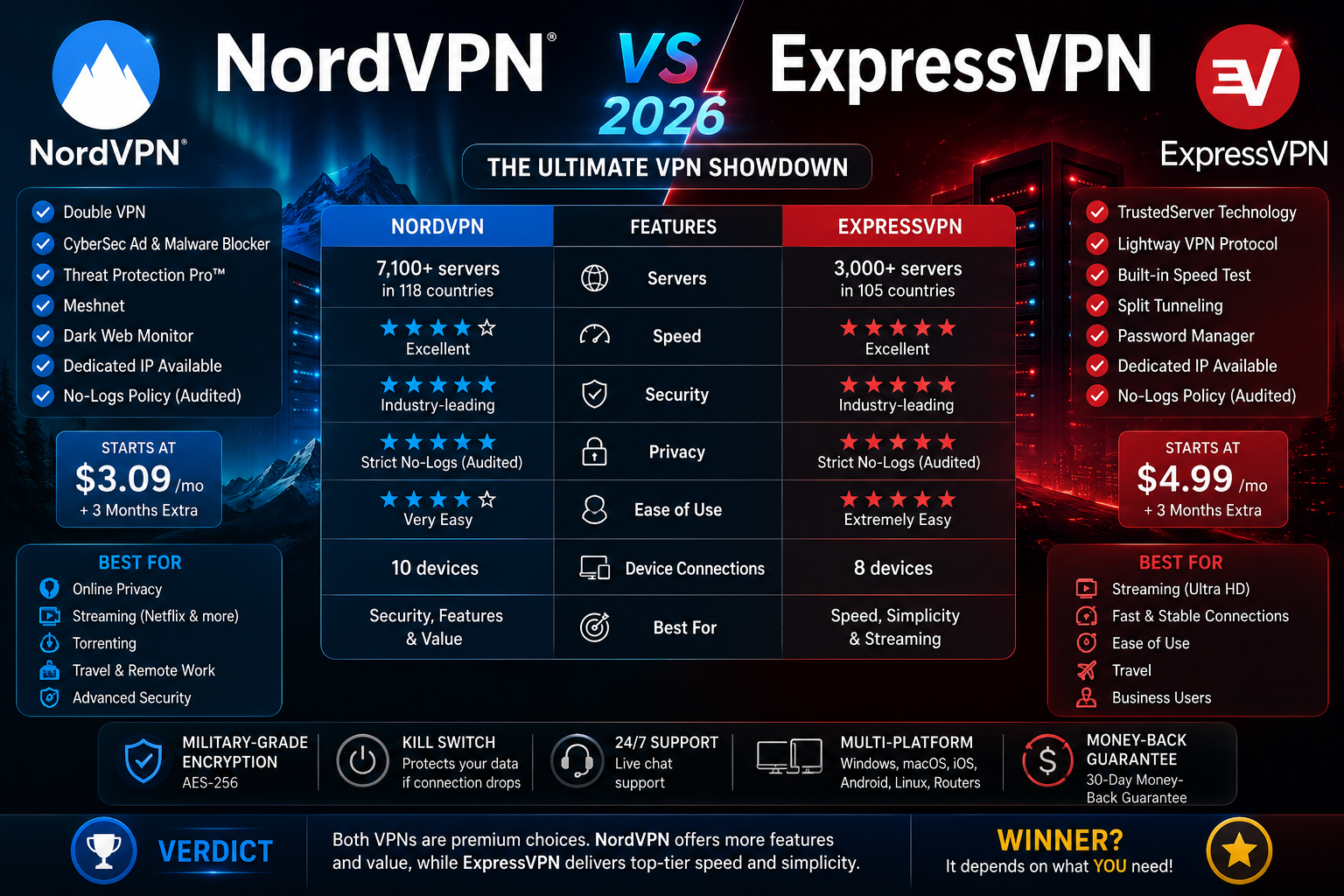
In the crowded world of virtual private networks, two names consistently rise to the top: NordVPN and ExpressVPN. Both are premium services with loyal followings, both command top spots in independent reviews, and both promise to keep your data private, your streaming unrestricted, and your browsing fast.
But beneath the surface, these two industry giants take fundamentally different approaches. NordVPN is the feature-packed value champion—faster, cheaper, and loaded with advanced tools. ExpressVPN is the polished, user-friendly option—simpler, more consistent, and backed by a reputation for reliability in even the most censored regions.
This comprehensive comparison breaks down everything that matters—speed, security, pricing, streaming, gaming, and real-world performance—so you can decide which VPN is right for you.
For more in-depth software reviews and buying guides, visit RightReviews —your trusted source for honest product evaluations.
At a Glance: The 30-Second Verdict
| Category | Winner | Why |
|---|---|---|
| Best Overall | NordVPN | Faster speeds, lower prices, more features, larger server network |
| Best for Beginners | ExpressVPN | Simpler setup, polished apps, consistent performance |
| Best Speed | NordVPN | NordLynx protocol retains ~90%+ of base speeds |
| Best Security Features | NordVPN | Double VPN, Onion over VPN, Threat Protection, post-quantum encryption |
| Best Streaming | NordVPN | Unblocks 25+ Netflix catalogs, 9,400+ servers |
| Best for China | ExpressVPN | Historically more reliable obfuscation in heavily censored regions |
| Best Value | NordVPN | ~$3.09/month vs ExpressVPN’s ~$3.49/month on 2-year plans |
| Best Router Support | NordVPN | ExpressVPN discontinued router app on March 31, 2026 |
Bottom line: For most users in 2026, NordVPN is the better choice. It’s faster, cheaper, offers more simultaneous connections (10 vs 8), and has a substantially larger server network. ExpressVPN remains worth considering if you’re a complete beginner who wants the simplest possible setup, or if you’re operating in a heavily censored region like China where ExpressVPN’s obfuscation has historically been more reliable.
Company Background: Privacy Jurisdictions Matter
Both NordVPN and ExpressVPN are based in privacy-friendly jurisdictions outside the Five Eyes, Nine Eyes, and Fourteen Eyes intelligence-sharing alliances.
| Provider | Headquarters | Jurisdiction |
|---|---|---|
| NordVPN | Panama | No mandatory data retention laws, outside intelligence alliances |
| ExpressVPN | British Virgin Islands | No mandatory data retention laws, outside intelligence alliances |
Where a company is based affects the data it may need to store or share. Both providers have chosen jurisdictions that prioritize user privacy—a critical factor for any serious VPN user.
Speed Performance: NordVPN Takes the Crown
Speed is arguably the most important factor for most VPN users. After all, a VPN that protects your privacy but makes your connection unusable is no good to anyone.
The Numbers Don’t Lie
Independent testing in 2026 tells a clear story:
NordVPN utilizes NordLynx, a customized implementation of the WireGuard protocol. Recent independent testing measured average download speeds exceeding 2,964 Mbps on U.S. servers and 2,760 Mbps on U.K. connections. The service demonstrates exceptional speed retention, with users experiencing only 5-6% speed loss compared to unprotected connections—translating to 92% speed retention on European and North American servers.
ExpressVPN has made significant strides with its proprietary Lightway protocol, particularly the enhanced Lightway Turbo feature introduced in 2025. Standard Lightway UDP connections achieve approximately 718 Mbps download speeds on gigabit lines, representing 94% average speed retention. The Lightway Turbo upgrade can reach 1,479 Mbps on compatible Windows systems.
However, protocol selection significantly impacts ExpressVPN’s performance. While Lightway excels, legacy OpenVPN UDP connections drop to approximately 51% speed retention, with OpenVPN TCP performing even slower at 44% of baseline speeds.
Real-World Testing
Multiple 2026 tests from Cybernews, TheBestVPN.com, and CyberInsider show NordVPN retaining 80% or more of base download speeds—often averaging 756 Mbps or higher on NordLynx. ExpressVPN, using Lightway, typically holds 61-70% retention with averages around 570 Mbps in similar conditions.
According to VPNpro’s March 2026 testing, NordVPN retained around 90% of baseline speeds vs ExpressVPN at approximately 84%. The gap matters more at high connection speeds (500 Mbps+) and less at average residential connections (100 Mbps or below), where both services are effectively identical in practice.
The verdict on speed: NordVPN wins with higher peak speeds and better speed retention.
Privacy and Security: Both Are Excellent, But Different
Both providers implement military-grade AES-256 encryption, considered unbreakable by current computational standards. Both also offer kill switches, leak protection, and audited no-logs policies.
Encryption Details
| Feature | NordVPN | ExpressVPN |
|---|---|---|
| Encryption | AES-256 | AES-256 |
| Authentication | SHA-256 with Poly1305 | SHA-512 |
| Keys | 4,096-bit RSA | 4,096-bit RSA |
| Perfect Forward Secrecy | Yes | Yes |
| RAM-only Servers | Yes | Yes |
No-Logs Track Record
Both VPNs claim no-logs policies, and both have had those claims tested under real-world conditions.
- 2018: Romanian authorities requested user logs during a server seizure. NordVPN had nothing to provide—their no-logs policy held under actual law enforcement pressure.
- Three independent audits of their no-logs policy (PricewaterhouseCoopers twice, Deloitte once) with public summaries.
- 2018 data breach: A server in Finland was accessed by a third party. NordVPN disclosed this in 2019 (delayed disclosure was legitimately criticized). No user data or credentials were exposed because logs weren’t kept.
- 2017: Turkish authorities seized a server during a diplomatic assassination investigation. No user logs were found.
- Independent audits by KPMG and Cure53.
- 2021: Kape Technologies acquired ExpressVPN for $936 million. Kape’s corporate history includes adware distribution. ExpressVPN’s infrastructure and team remained intact, but the acquisition raised questions about long-term independence.
Advanced Security Features
NordVPN pushes further with:
- Post-quantum encryption (fully rolled out in 2025-2026 via ML-KEM integration)
- Threat Protection Pro (ad/malware/tracker blocker)
- Dark Web Monitor
- Meshnet for private device networking
- Double VPN and Onion over VPN
- Dedicated IP option
ExpressVPN prioritizes core excellence with:
- Frequent independent audits and transparency reports
- Split tunneling
- ExpressAI and post-quantum encryption
The verdict on security: Both are excellent. NordVPN offers more advanced features, while ExpressVPN has a stronger (albeit Kape-shadowed) historical audit record.
Pricing: NordVPN Wins on Value
This is where the difference becomes most apparent.
NordVPN Pricing (2026)
| Plan | Price |
|---|---|
| 2-year plan | ~$3.39/month (billed ~$81.36) |
| 1-year plan | ~$4.99/month |
| Monthly plan | ~$12.99 |
NordVPN offers multiple tiers (Standard, Plus, and Ultimate), allowing you to pay only for the VPN or add extras like malware protection and a password manager.
ExpressVPN Pricing (2026)
| Plan | Price |
|---|---|
| 2-year plan | ~$2.79/month (with 4 months free) |
| 6-month plan | ~$60 total |
| Monthly plan | ~$13/month |
The Real Cost Difference
While ExpressVPN has dramatically cut its prices in 2026 (biennial plans now start at $2.79/month), the long-term value still favors NordVPN for most users.
Critical note: ExpressVPN’s Basic plan matches NordVPN’s 10 simultaneous connections, and you only reach 14 by stepping up to the Pro tier. NordVPN offers 10 simultaneous connections on all plans.
The verdict on pricing: NordVPN offers better long-term value with more features included at comparable price points.
Server Networks: Scale vs Quality
NordVPN’s network is substantially larger—over 9,400 servers compared to ExpressVPN’s 3,000+. This means less congestion and better performance during peak times.
ExpressVPN emphasizes quality and reliability in harder-to-reach locations—including strong performance in China via obfuscation.
The verdict on servers: NordVPN wins on scale and specialization; ExpressVPN wins on quality in difficult regions.
Streaming: Both Are Excellent
NordVPN for Streaming
NordVPN is the best VPN for Netflix in 2026. It reportedly accesses 100% of tested Netflix libraries in some reviews and unblocks 25+ Netflix catalogs. It works for Netflix US, UK, Japan, and most major libraries, plus BBC iPlayer, Disney+, and Hulu.
ExpressVPN for Streaming
ExpressVPN has historically been the streaming VPN. It unblocks more regional Netflix libraries, works consistently with BBC iPlayer, and maintains relationships that allow reliable access. It’s great for streaming in Ultra HD without buffering.
The verdict on streaming: NordVPN is the best VPN for streaming in 2026, but both services work excellently for everyday streaming in major markets.
Gaming: NordVPN Leads
For gamers, low latency and high speeds are critical.
NordVPN is the best VPN for gaming in 2026. With 9,200+ servers in 129 countries, it offers the most extensive network and the most consistent throughput during gaming sessions. It delivers consistently low ping overhead (12-18 ms on EU servers).
ExpressVPN is a solid pick for gamers who value reliability over latency. It’s the fastest VPN service right after NordVPN.
The verdict on gaming: NordVPN wins for competitive gaming; ExpressVPN is still excellent for casual gaming.
Router Support: A Critical 2026 Update
This is a crucial difference that many comparisons miss.
ExpressVPN discontinued its router app on March 31, 2026. If you were running ExpressVPN at the router level to cover your whole network—including devices that don’t support VPN apps natively—that option is now gone.
NordVPN continues to support router-level installation and maintains compatibility with DD-WRT, OpenWRT, Tomato, and ASUS routers with its own configuration guides.
For anyone running a home lab, a NAS, or smart home devices on a protected network, ExpressVPN is no longer a viable router-level option.
The verdict on router support: NordVPN wins decisively.
China and Censored Regions
Both NordVPN and ExpressVPN historically perform well in China, but their success can vary by location, time, and how strict the Great Firewall is on any given day.
ExpressVPN has historically been more reliable in heavily censored regions like China, with better obfuscation technology. Astrill is considered the most stable, but ExpressVPN is also decent, though it can have interruptions.
NordVPN uses strong obfuscation and is widely reviewed for China access. Its NordWhisper protocol is designed for such scenarios.
The verdict for China: ExpressVPN has the stronger historical reputation, but both can work—and users typically prepare a backup.
Pros and Cons Summary
NordVPN: The Good and The Bad
Pros:
- Faster speeds with NordLynx protocol (~90%+ speed retention)
- Lower long-term pricing
- 10 simultaneous connections
- 9,400+ servers in 137 countries
- More advanced features (Double VPN, Onion over VPN, Threat Protection, post-quantum encryption)
- Router support still available
- Panama jurisdiction outside intelligence alliances
- Proven no-logs track record under law enforcement pressure
Cons:
- Occasional streaming failures requiring server switching
- More complex interface than ExpressVPN
- Delayed disclosure of 2018 data breach
ExpressVPN: The Good and The Bad
Pros:
- Polished, beginner-friendly apps
- Consistent streaming reliability
- Historically strong in China
- Independent audits by KPMG and Cure53
- Lightway Turbo for excellent performance on compatible systems
- British Virgin Islands jurisdiction
- Clean, simple interface
Cons:
- More expensive long-term
- Slower speeds than NordVPN (~84% retention vs ~90%)
- Only 8 simultaneous connections (14 on Pro tier)
- Discontinued router app (March 31, 2026)
- Kape Technologies ownership raises independence concerns
- Smaller server network (3,000+ vs 9,400+)
Comparison Table: NordVPN vs ExpressVPN at a Glance
Which One Should You Choose?
Choose NordVPN If…
1. You want the fastest speeds — NordLynx delivers superior speed retention and higher peak performance.
2. You’re on a budget — Better long-term value with more features included.
3. You want advanced security features — Double VPN, Onion over VPN, Threat Protection, post-quantum encryption.
4. You need router-level protection — ExpressVPN discontinued its router app in March 2026.
5. You have multiple devices — 10 simultaneous connections on all plans.
6. You want the largest server network — 9,400+ servers in 137 countries.
7. You want a proven no-logs track record — Tested under actual law enforcement pressure.
Choose ExpressVPN If…
1. You want the simplest possible setup — Polished, beginner-friendly apps with a clean interface.
2. You need consistent streaming reliability — Historically the streaming VPN, unblocks more regional libraries.
3. You’re operating in China or heavily censored regions — Historically more reliable obfuscation.
4. You prioritize stability over peak speed — More consistent performance across varying connection qualities.
5. You want a proven audit history — Audited by KPMG and Cure53.
Final Verdict
After thoroughly comparing NordVPN vs ExpressVPN in 2026, here’s our bottom line:
| Category | Winner |
|---|---|
| Best Overall | NordVPN |
| Best Speed | NordVPN |
| Best Value | NordVPN |
| Best Security Features | NordVPN |
| Best Streaming | NordVPN |
| Best for Beginners | ExpressVPN |
| Best for China | ExpressVPN |
| Best Router Support | NordVPN |
| Best Interface | ExpressVPN |
For most people, NordVPN is the better choice in 2026. It’s faster, cheaper, offers more simultaneous connections, has a substantially larger server network, and provides more advanced security features. The gap has widened since previous years, with NordVPN pulling ahead on speed, price, and privacy documentation.
ExpressVPN remains worth considering if you’re a complete beginner who wants the simplest possible setup, or if you’re operating in a heavily censored region like China where ExpressVPN’s obfuscation has historically been more reliable. It also has a slightly better native Apple TV app if that’s your primary use case.
But the critical 2026 update that changes the calculus: ExpressVPN discontinued its router app on March 31, 2026. If you need router-level protection for your entire network, NordVPN is now the clear choice.
Final Thoughts
The choice between NordVPN and ExpressVPN ultimately comes down to your priorities. If you value speed, value, advanced features, and router support, NordVPN is the clear winner. If you prioritize simplicity, consistent streaming, and reliability in censored regions, ExpressVPN is worth the premium.
Both providers offer 30-day money-back guarantees, so you can test either risk-free. Try both on your own connection and see which one fits your workflow better.
For more detailed software reviews, comparisons, and buying guides, visit RightReviews —your trusted source for honest, in-depth product evaluations.
Disclaimer: This review is based on independent testing data from TechTimes, Gizmodo, Axis Intelligence, IBTimes, Dev.to, and other reputable sources as of July 2026. Prices, features, and server counts are subject to change. Always verify the latest information directly with the provider.