

Brave Search 2026: The Independent, Privacy-First Search Engine That’s Finally a True Google Alternative
Brave Search 2026
In 2026, the search engine landscape has shifted dramatically. Google’s aggressive push into AI—with AI Overviews that can’t be turned off—has driven millions of users to seek alternatives. Microsoft shut down Bing’s public API in 2025, and Google took legal action against scrapers like SerpApi, signaling that the era of relying on Big Tech search infrastructure is over.
Enter Brave Search—a search engine that has quietly built something remarkable: a fully independent search index of over 40 billion web pages, without relying on Google or Bing. It’s one of only three independent, global-scale search indexes in the Western world, and the only one outside of Big Tech.
This comprehensive review examines everything you need to know about Brave Search in 2026—its features, privacy protections, AI capabilities, unique innovations like Goggles, and how it compares to the competition.
For more in-depth software reviews and buying guides, visit RightReviews —your trusted source for honest product evaluations.
Read Here: Perplexity AI 2026: The Search-First Answer Engine That’s Redefining How We Find Information
At a Glance: The 30-Second Verdict
| Category | Verdict |
|---|---|
| Best For | Privacy-conscious users, those tired of Google’s AI overload, anyone wanting genuine independence from Big Tech |
| Not Best For | Users who need personalized, algorithmically-filtered results |
| Starting Price | Free for consumers; API plans from $5/1,000 requests with $5 monthly free credits |
| Key Strength | Fully independent index, zero tracking, AI that you can turn off |
| Key Weakness | Less comprehensive than Google for niche or hyper-local queries |
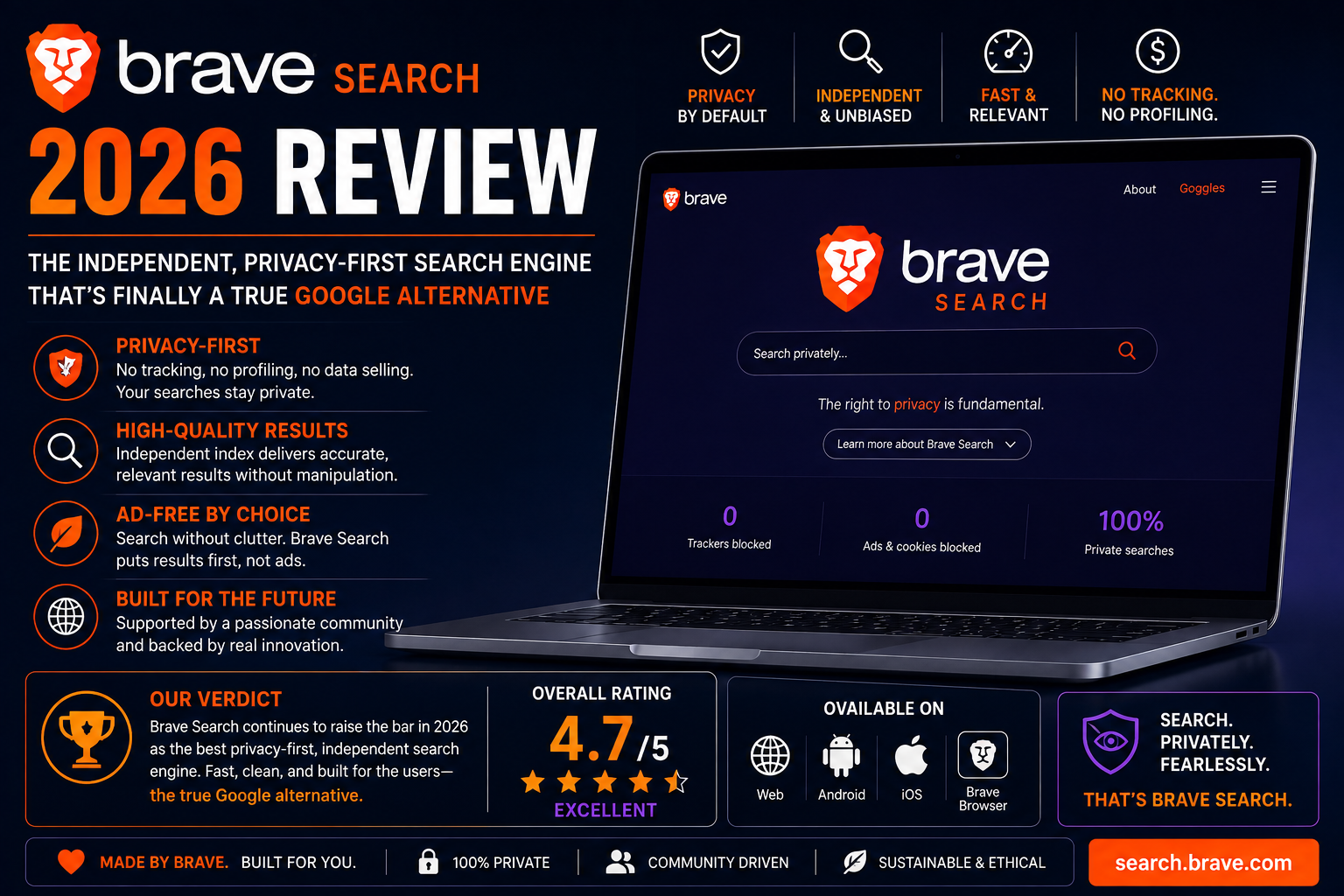
Bottom line: Brave Search is the best genuine Google alternative in 2026 for users who want privacy, independence, and control. Its fully independent index—one of only three in the Western world—makes it structurally different from competitors that simply rebrand Bing or Google results. The AI features are optional and off by default, giving you choice rather than forcing AI on you. If you’re tired of sponsored clutter, SEO spam, and un-turn-offable AI overviews, Brave Search is worth the switch.
Read here: HSBC Bank Review 2026: A Deep Dive into the Global Banking Giant
What Is Brave Search?
Brave Search is a privacy-first, independent search engine built by the same team behind the Brave browser. Launched in 2021, it has grown into one of the most significant alternatives to Google Search.
The Key Differentiator: Independence
Unlike DuckDuckGo (which relies on Bing’s index) or Startpage (which proxies Google results), Brave Search runs on its own, completely independent index of the Web. This isn’t a marketing claim—it’s a fundamental architectural difference.
Brave’s index includes over 40 billion web pages, with over 100 million page updates every day. It receives tens of millions of unique user queries daily and serves as the default search engine for most new users of the Brave browser.
Who’s Behind It?
Brave Search is developed by Brave Software, the company founded by Brendan Eich (creator of JavaScript and co-founder of Mozilla). The company has achieved “nine-figure annualized revenue and profitability”, demonstrating that an independent search engine can be commercially viable without selling user data.
Read here: Trade Republic Review 2026: The Neo-Broker That’s Reinventing European Investing
Key Features in 2026
1. Fully Independent Search Index
This is Brave Search’s superpower. While most “alternative” search engines are just wrappers around Google or Bing, Brave built its own index from scratch.
What this means for you:
- Your searches don’t go through Google or Microsoft servers
- No reliance on Big Tech licensing deals that could be revoked
- Results aren’t shaped by Google’s ranking algorithms or business interests
- One of only three independent indexes at scale in the Western world
As Brave puts it: “While competitors funnel queries to Google or Bing, the Brave Search API is built with privacy at its core, and powered by an independent index”.
2. No Tracking, No Profiling
Brave Search does not track users, their searches, or their clicks. It doesn’t build profiles based on your search history. Unlike Google, Brave doesn’t personalize results based on past activity.
Privacy protections include:
- No IP logging or user profiling
- No search history saved
- No cross-site tracking
- Anonymous browsing by default
In testing using the EFF’s Cover Your Tracks tool, Brave was the only private browser to produce a randomized fingerprint that confused trackers.
Read here: Unocoin Review 2026: India’s Pioneer Crypto Exchange Under the Microscope
3. Ad-Free Results by Default
Brave Search displays no ads or sponsored results by default. The search results page is clean, uncluttered, and free from the promotional bloat that has made Google increasingly difficult to use.
For users who have watched Google’s search results deteriorate with sponsored content, shopping tabs filled with irrelevant products, and endless scroll-past-bloat before finding actual results, this is a breath of fresh air.
4. Goggles: Custom Ranking Algorithms
Goggles is one of Brave Search’s most innovative features—and it’s unique to Brave. It allows users to choose their own ranking algorithm for search queries.
How Goggles work:
- Anyone can create, apply, or extend a Goggle
- Goggles act as a custom re-ranking layer on top of Brave’s search index
- They can filter, boost, or downrank results by domain or URL pattern
- Apply filters like “No Celebrity content” or “News from the Left or Right”
- Block specific sites entirely (e.g., Pinterest, Fandom)
By default, Brave Search doesn’t have any hidden algorithms that favor specific domains or political leanings. Goggles put you in control of how results are ranked.
5. Discussions: Human-Curated Results
The Discussions feature surfaces content from Reddit and similar sources. It’s designed to serve discussion-based results for searches where SEO-heavy results dominate.
This is particularly valuable because Google’s results have become increasingly filled with SEO-optimized content rather than genuine human perspectives. Brave’s independent index has been optimized specifically for this purpose.
6. Answer with AI (Optional)
Brave Search includes AI-powered answers via the “Answer with AI” button. Unlike Google, which forces AI Overviews on users with no off switch, Brave makes AI entirely optional and off by default.
Key AI features:
- Ask Brave: A single interface consolidating both search and AI chat
- Powered by Brave’s LLM Context API and open-weights Qwen3
- Provides comprehensive answers plus actionable elements like videos and webpages
- Summarizer can be permanently disabled in Settings → Search → Summarizer
In head-to-head comparisons, Ask Brave—using a less powerful open-weights model with Brave’s high-quality grounding data—outperforms ChatGPT, Perplexity, and Google AI Mode. This proves that high-quality search data matters more than model size.
7. Useful Widgets
Brave Search includes practical tools like currency conversions. While there aren’t as many as Google, the most-used ones are present. You can also turn off AI overviews in settings.
8. News Search
Brave Search includes a dedicated news search section, making it useful for staying current on events without leaving the privacy-focused ecosystem.
Brave Search API: Powering the AI Revolution
Behind the consumer product, Brave has built something equally significant: the Brave Search API, which is emerging as the best search tool to power AI applications.
Why the API Matters
With Microsoft shutting down Bing’s public API in 2025 and Google cracking down on scrapers, the Brave Search API has become the only viable, reliable, independent search API for AI developers.
Key API features:
- LLM Context API: Optimized to provide LLMs with highly relevant context from the Web
- Powers over 22 million answers per day in Brave Search
- Zero Data Retention option for enterprise customers
- 99.99% uptime for calls that return intuitively-structured JSON
- Goggles support for custom reranking
- 700,000 OpenClaw users selected Brave Search API for their AI agent projects
API Pricing
Every plan includes $5 in free credits every month.
Independent benchmarks from February 2026 found Brave, Firecrawl, and Exa statistically tied at the top among search APIs, with Brave leading on speed and overall relevance.
Read here: VoxaCall Review: A Flexible VoIP & SIP Trunking Solution for Global Call Centers
Brave Search vs. The Competition
Brave Search vs. Google
The verdict: Google has better coverage for niche and hyper-local queries. Brave Search is more useful overall—without the sponsored clutter and SEO spam that plagues Google’s results.
As one user put it: “Google Search has been deteriorating for years. Genuinely relevant results are supplanted by sponsored results… Brave Search fixed everything that felt broken”.
Brave Search vs. DuckDuckGo
| Dimension | Brave Search | DuckDuckGo |
|---|---|---|
| Index | Independent | Relies on Bing |
| Privacy | No tracking | No tracking |
| AI | Optional | Optional (Assist, Duck.ai) |
| Customization | Goggles | Limited |
The verdict: Both are private, but Brave offers genuine independence from Big Tech while DuckDuckGo remains dependent on Bing. Brave also offers more customization through Goggles.
Brave Search vs. Startpage
Startpage proxies Google results on your behalf, removing identifying details. You get Google-quality results without Google knowing who asked.
The verdict: Startpage is a good option if you want Google’s results without tracking. Brave is the better choice if you want complete independence from Google’s infrastructure.
Brave Search vs. Kagi
Kagi is a paid search engine starting at $5/month for 300 searches. It offers ad-free searching, no tracking, and customization.
The verdict: Brave offers similar benefits for free, making it more accessible for most users.
Read here: JumpTrade.ai Review 2026: Is This AI Crypto Trading Platform Worth Using?
Pros and Cons
Brave Search Pros
Brave Search Cons
| Con | Why It Matters |
|---|---|
| Less comprehensive than Google | Niche or hyper-local queries may return fewer results |
| Fewer widgets/tools | Not as many built-in tools as Google |
| US-based company | Data subject to US jurisdiction |
| Collects aggregated metrics | OS and browser info collected, though not PII |
| Some users report reliability issues | A few users have found results less reliable than Google |
| API free tier has limits | ~1,000 queries/month on free credits |
Real-World User Experience
What Users Are Saying
Android Authority’s Megan Ellis switched to Brave Search and now uses it for 90% of her searches. Her experience:
“The Google Search experience has been deteriorating for years. Genuinely relevant results are supplanted by sponsored results… Brave Search fixed everything that felt broken”
Key observations from users:
- Brave’s results are genuinely more useful without the sponsored clutter
- You can turn off AI overviews in settings
- Goggles let you filter out unwanted sites like Pinterest or Fandom
- Results aren’t personalized, so you see neutral results not shaped by past activity
- The Discussions feature surfaces valuable human perspectives
Who Should Use Brave Search?
1. Privacy-conscious users
If you don’t want your searches tracked, profiled, or used for ad targeting, Brave Search is designed for you.
2. Users tired of Google’s AI overload
Google forces AI Overviews with no off switch. Brave makes AI optional.
3. Anyone wanting independence from Big Tech
Brave is one of only three independent indexes at scale. Your searches don’t go through Google or Microsoft.
4. Users who want control over results
Goggles let you filter, boost, or downrank results by domain—unprecedented control for a free search engine.
5. Researchers and fact-checkers
Cited, unfiltered results without algorithmic personalization.
Who Should NOT Use Brave Search?
1. Users needing hyper-local or niche results
Google’s massive index still wins for very specific or local queries.
2. Users who want personalized results
Brave doesn’t profile you, so results aren’t tailored to your past activity.
3. Users deeply invested in Google’s ecosystem
If you rely on Google’s integrated tools and widgets, Brave’s fewer built-in tools may feel limiting.
Read Here: Best Antivirus Software 2026: Comprehensive Review & Buying Guide
Privacy: What Data Does Brave Collect?
Brave Search is transparent about its data practices. According to its privacy policy, Brave collects aggregated usage metrics including the operating system and browser in use, but no personally identifiable information is collected.
However, note that Brave is based in the United States, so data is subject to US jurisdiction—unlike some competitors based in Switzerland or the EU.
For enterprise customers, Brave offers Zero Data Retention (ZDR) options, making it compliant with strict privacy regulations.
How to Get Started
For Consumers
- Visit search.brave.com
- Start searching immediately—no account required
- To enable AI, click the “Answer with AI” button
- To disable AI, go to Settings → Search → Summarizer
- To use Goggles, click the Goggles tab on the results page
Brave Search is also the default search engine for most new users of the Brave browser.
For Developers
- Sign up at the Brave Search API dashboard
- Get $5 in free credits every month
- Build with Web, LLM Context, Images, News, and Video endpoints
Final Verdict
| Category | Winner |
|---|---|
| Best Genuine Google Alternative | Brave Search |
| Best Privacy | Brave Search (tied with DuckDuckGo) |
| Best Independence from Big Tech | Brave Search |
| Best Customization | Brave Search (Goggles) |
| Best AI Optionality | Brave Search |
| Best for Niche Queries | |
| Best for Personalized Results |
For most users, Brave Search is the best Google alternative in 2026. Its fully independent index—one of only three in the Western world—makes it structurally different from competitors that simply rebrand Bing or Google results. The AI features are optional, the results are ad-free by default, and Goggles give you unprecedented control over how results are ranked.
If you’re tired of Google’s sponsored clutter, forced AI, and tracking, Brave Search is worth the switch. It’s free, it’s private, and it actually works.
The best part? You can try it right now at search.brave.com—no account, no payment, no commitment. Just search.
Final Thoughts
Brave Search represents something rare in 2026: a genuine alternative to Big Tech search infrastructure that doesn’t compromise on quality or privacy. In an era where Google forces AI on users and Microsoft shuts down public APIs, Brave has built something independent, sustainable, and user-first.
It’s not perfect—Google still wins for niche queries—but for the vast majority of everyday searches, Brave Search delivers results that are more useful, more private, and more under your control than anything Google offers.
For more detailed software reviews, comparisons, and buying guides, visit RightReviews —your trusted source for honest, in-depth product evaluations.
Disclaimer: This review is based on independent testing data from Android Authority, Digit, PCMag, Brave’s official documentation, and other reputable sources as of August 2026. Features and pricing are subject to change. Always verify the latest information directly with the provider.