

HSBC Bank Review 2026: A Deep Dive into the Global Banking Giant
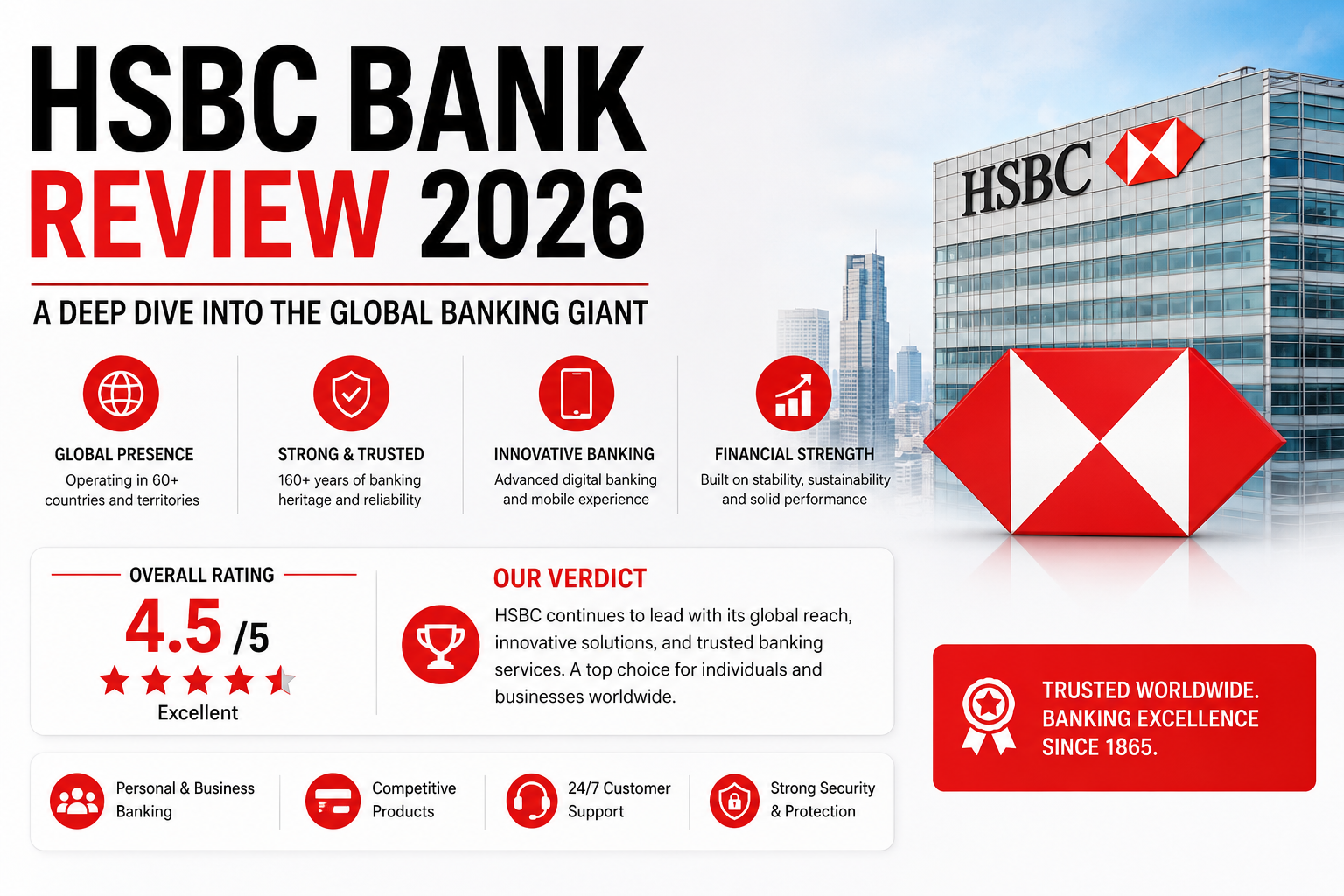
HSBC Holdings plc is a name synonymous with international banking, a financial behemoth with roots tracing back to 1865 in Hong Kong and Shanghai. Today, headquartered in London, it stands as one of the largest banks in the world, with over $3 trillion in assets, 40 million customers, and a presence in more than 50 countries . This review provides a detailed, objective analysis of HSBC in 2026, covering its financial health, strategic direction, key products for personal and business banking, fees, and overall suitability for different types of customers.
Overview and Financial Health in 2026
HSBC’s recent performance has been marked by resilience and strategic transformation. The bank has been navigating a complex environment of global economic uncertainty, geopolitical tensions, and regulatory changes, while simultaneously executing a significant restructuring plan.
Strong Core Business Performance
In Q1 2026, HSBC demonstrated the strength of its core operations. Excluding one-off items, total revenue grew 4% year-over-year to $19.1 billion . This growth was largely fueled by a 6% increase in fee and other income, which surged 32% quarter-over-quarter to $7.9 billion, driven by particularly strong wealth management fees . However, net interest income softened slightly to $11.3 billion due to interest rate dynamics, though management remains confident, raising its full-year 2026 guidance to approximately $46 billion .
The bank’s underlying profitability is robust. Return on Tangible Equity (RoTE), a key measure of efficiency, rose from 15.6% in 2024 to 17.2% in 2025 and further to 18.7% in Q1 2026 . This is well above its medium-term target of over 17% annually, firmly securing its position among top-tier global systemically important banks (G-SIBs) .
Strategic Restructuring and Focus
HSBC has been undergoing a multiyear restructuring to simplify its footprint, reduce costs, and exit underperforming businesses . Key elements of this strategy include:
- Geographic Focus: Sharpening its focus on its two core markets: Hong Kong and the United Kingdom. These are markets where it benefits from leading deposit franchises and strong brand recognition .
- Simplification and Cost Savings: The bank is streamlining its organizational structure, having reduced senior management roles and non-tech staff . It is on track to achieve approximately $1.5 billion in annualized savings by the end of 2026 .
- Divestitures: HSBC has completed or announced the sale of its businesses in the United States, Canada, New Zealand, France, Argentina, and others, while also winding down investment banking activities in the UK, Europe, and the US .
Prudent Risk Management
Despite strong earnings, HSBC is not without its challenges. In Q1 2026, pre-tax profit, excluding one-offs, edged down 4% year-over-year to $9.4 billion . This shortfall was primarily due to higher expected credit losses (ECL) and provisions related to Middle East tensions . Management lifted its full-year 2026 ECL guidance to about 45bps, up from 40bps, reflecting a deliberately prudent stance in light of geopolitical risks . Importantly, this increase in provisions mainly reflects short-term uncertainty rather than a weakening of core credit quality .
Capital and Shareholder Returns
HSBC maintains a solid capital position. Its Common Equity Tier 1 (CET1) ratio dropped to 14.0% in Q1 2026 following the privatization of Hang Seng Bank and other initiatives, but it remains within management’s target range of 14.0–14.5% . The bank has been consistently rewarding shareholders, with a 50% dividend payout ratio and a history of share buybacks . The cash dividend yield alone provides a return of nearly 5% . Erste Group Bank recently downgraded HSBC to a “Hold” with a mixed analyst backdrop .
Key Products and Services
HSBC offers a comprehensive suite of banking products for individuals and businesses alike.
Personal Banking in the U.S.
For individual customers in the United States, HSBC offers checking accounts, savings accounts, and credit cards. However, its physical presence is limited to fewer than 150 branches in just six states (CA, FL, NJ, NY, VA, WA) plus the District of Columbia .
Checking & Savings Accounts
HSBC’s account structure is largely geared toward wealthier clients, with “Premier” and “Jade” tiers offering premium services and benefits . The HSBC Premier Savings account requires a Premier Checking account to qualify. The monthly maintenance fee of $50 can be avoided by maintaining a $75,000 minimum combined balance, having recurring direct deposits of $5,000, or carrying a $500,000 HSBC U.S. residential mortgage . The APY on the Premier Relationship Savings account is 3.20% as of April 2026, significantly higher than the 0.05% rate for customers who don’t meet the activity requirements .
Credit Cards
HSBC offers premium credit cards with travel perks:
- HSBC Premier World Mastercard: No annual fee for Premier customers (otherwise $95). Offers 3X points on gas and groceries, 2X points on travel, and a sign-up bonus.
- HSBC Elite Mastercard: Has a $495 annual fee, waived for Premier customers. Offers a $400 annual travel credit, airport lounge access, and 5X points on travel, but comes with a high annual fee .
Important Note on HSBC U.S. Credit Cards: Interest rates can be high. The Key Facts Statement for HSBC Hong Kong credit cards lists an interest rate of 31.8% for retail purchases and cash advances, translating to an APR of 35.42% . While rates may vary by region, this highlights the importance of paying balances in full.
Business Banking and International Services
For businesses, HSBC’s strength lies in its global network and services for international trade. It offers a range of accounts and tools for businesses operating across multiple markets.
HSBC Multi-Currency Accounts
Businesses can manage multiple currencies through options like the International Current Account (for holding foreign currency) and the HSBC Global Wallet (for sending, receiving, and holding currency from Business Internet Banking) . The Global Wallet supports currencies like AUD, CAD, CNY, EUR, HKD, JPY, SGD, CHF, and USD .
Fees for International Business
HSBC’s multi-currency accounts are best for businesses already banking with them. Costs can add up for frequent international transactions. Key fees include:
- Annual International Account fee: £96, £120, or £180 per account .
- Online international payment (SWIFT): £17 per transaction .
- Global Wallet local-style payment/receipt: £5 per transaction .
- Incoming payments in other currencies of £100+: £6 .
Pros and Cons of HSBC
Pros
- Global Footprint: Unmatched international presence, making it ideal for businesses and individuals who travel or work across borders. Access to branches and ATMs in nearly 60 countries .
- Strong Financial Health and Shareholder Returns: High RoTE, consistent dividend payouts, and a solid balance sheet .
- Wealth Management: Comprehensive services for affluent clients, including high-end credit cards and premier banking.
- Trade Finance & FX: Strong infrastructure and support for businesses engaged in international trade .
Cons
- Limited U.S. Presence: Fewer than 150 branches in only six states, with a separate website for HSBC Direct, creating potential confusion .
- Complex and High Fees: Fee structures for business accounts can be complicated and potentially expensive for smaller companies . Personal accounts have high minimum balance requirements to avoid monthly fees .
- High Penalty Fees: Significant penalties for overdrafts, late payments, and insufficient funds. Overdraft protection via “Select Credit” can cost up to 17.99% APR plus a transaction fee .
- Premium Focus: Most of its best products and services are geared toward wealthier Premier and Jade customers .
Conclusion: Is HSBC Right for You?
HSBC in 2026 is a bank undergoing a successful transformation, emerging as a more focused, efficient, and profitable institution. Its strategic divestments and emphasis on its core markets are paying off .
HSBC is best suited for:
- International travelers and expatriates who value seamless global banking.
- Businesses with significant international operations that need trade finance, multi-currency accounts, and a global partner .
- Affluent individuals (Premier/Jade clients) who can benefit from the premium services, high-end credit cards, and wealth management offerings.
HSBC is less suitable for:
- U.S.-based customers who prefer frequent branch access and clear, simple fee structures.
- Small businesses or startups that primarily operate domestically and don’t need a global banking relationship.
- Cost-conscious customers who would be weighed down by high fees and minimum balance requirements.
Ultimately, HSBC is a global powerhouse for those who need one. Its rich history, extensive network, and modern strategic focus provide a strong foundation, but its services and fees are clearly tailored for a specific type of customer.