


Best Website Builders 2026: Comprehensive Review & Buying Guide
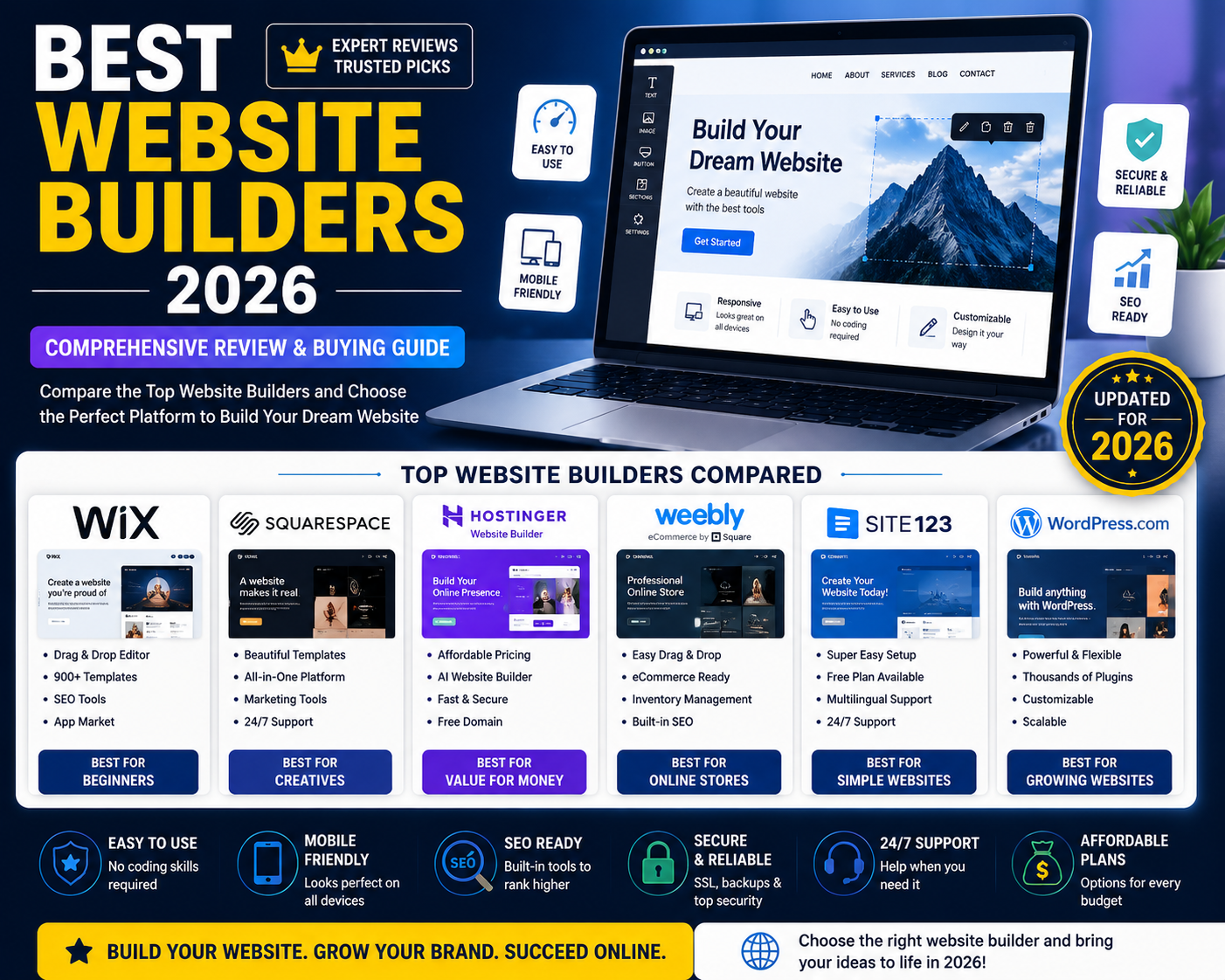
In 2026, your website is your digital storefront, portfolio, and often your first impression—and you don’t need to know a single line of code to build a stunning one. Website builders have evolved from basic page creators into powerful, all-in-one platforms that combine design, hosting, e-commerce, AI-powered tools, and marketing automation under one roof.
The numbers tell the story: 71% of small businesses now have an official website, up from just 50% in 2018. With 75% of consumers judging a company’s credibility based purely on its website design, choosing the right platform isn’t just a technical decision—it’s a business imperative.
The good news? The website builder market in 2026 is more competitive and feature-rich than ever. From AI-powered site generators that build a complete website from a simple prompt, to enterprise-grade e-commerce platforms that can handle millions in annual revenue, there’s a solution for every need and budget.
This comprehensive review cuts through the noise. We’ve analyzed the leading website builders of 2026 across the metrics that actually matter—ease of use, design quality, features, e-commerce capabilities, SEO tools, pricing, and scalability. Whether you’re launching your first blog, building a creative portfolio, or starting an online store, we’ll help you find the platform that brings your vision to life.
For more in-depth software reviews and buying guides, visit RightReviews —your trusted source for honest product evaluations.
What Is a Website Builder and Why Do You Need One?
A website builder is a software platform that allows you to create a website without writing code. Instead of hiring a developer or learning HTML, CSS, and JavaScript, you use drag-and-drop interfaces, pre-designed templates, and intuitive editing tools to design and publish your site.
Why Website Builders Have Become Essential
1. Speed to Market
In 2026, you can go from idea to live website in under an hour with most modern builders. The traditional approach of coding from scratch or using a CMS like WordPress with manual hosting setup can take days or weeks.
2. Democratized Design
Professional-quality design is no longer the exclusive domain of trained designers. Platforms offer hundreds of templates created by professional designers, making it possible for anyone to create a polished, visually impressive site.
3. All-in-One Convenience
The best website builders bundle hosting, domain registration, security (SSL), analytics, and SEO tools into a single platform. This eliminates the need to manage multiple services and reduces technical complexity.
4. Built-In AI and Automation
AI is the new baseline in 2026, with 25% of business owners demanding AI-assisted design tools. Modern builders use artificial intelligence to generate layouts, write copy, optimize images, and even suggest improvements to increase conversions.
5. Mobile-First Is Mandatory
With 58.67% of web traffic coming from mobile devices, every major builder now ensures your site looks perfect on phones and tablets without extra work.
Types of Website Builders Explained
Before diving into our top picks, it’s essential to understand the different categories:
Drag-and-Drop Website Builders
Best for: Beginners, small businesses, portfolios
How it works: You drag elements (text, images, buttons) onto a canvas and position them anywhere. No coding required.
Examples: Wix, Squarespace, Weebly
AI-Powered Website Builders
Best for: Users who want the fastest possible setup
How it works: You answer a few questions about your business or describe what you want, and the AI generates a complete website design and structure in minutes.
Examples: Wix AI, Squarespace Blueprint AI, Hostinger Horizons
E-Commerce Website Builders
Best for: Online retailers
How it works: Specialized for selling products, with built-in payment processing, inventory management, shipping, and tax calculation.
Examples: Shopify, BigCommerce, Wix Ecommerce
Content Management Systems (CMS)
Best for: Blogs, content-heavy sites, users who need maximum flexibility
How it works: You manage content through a backend dashboard, with extensive plugin ecosystems for adding functionality.
Examples: WordPress (with or without page builders like Elementor)
Low-Code / No-Code Platforms
Best for: Designers and developers who want professional-grade customization without full coding
How it works: Visual design tools that generate clean code, offering more control than drag-and-drop builders.
Examples: Webflow, Framer
Best Paid Website Builders in 2026
1. Wix — Best Overall Website Builder
Wix consistently tops expert reviews in 2026, earning recognition as the best overall website builder from PCMag, ZDNET, The Independent, Crazy Egg, and Digital Trends.
Key Features:
- 800+ professionally designed templates across every industry
- AI Website Generator—tell it what kind of site you need, and it builds a customized site in minutes
- True drag-and-drop editor—place any element anywhere on the page with no grid constraints
- Wix Velo—a full-stack development platform for custom web applications
- App Market with hundreds of free and paid widgets for bookings, events, restaurants, and more
- Integrated analytics—track visitor behavior natively without Google Analytics
- A/B testing capabilities to serve different page versions and see which performs best
- 99.99% uptime benchmark for high availability
- 24/7 monitoring, SSL, and automated backups
Ease of Use: Wix offers the easiest full-featured website builder experience in 2026. Its drag-and-drop editor is simple for first-timers yet powerful for experienced users. The Quick Actions panel is genuinely helpful for beginners.
Design Quality: With over 2,000 templates across industries, you can find a design that matches your vision. All templates are responsive, SEO-friendly, and fully customizable. You can add or remove sections, adjust global styles, and reposition elements freely.
E-Commerce: Wix supports secure payments and a full set of selling and marketing tools on Business and Ecommerce plans. It can handle blogs, portfolios, restaurants, bookings, events, and more.
AI Capabilities: Wix’s AI tools can generate entire websites based on user preferences, helping beginners build a functional site quickly. Independent testing found that Wix AI struck the best balance between generation and control.
Pricing: Plans start at **$17/month** for Light, $29/month for Core, and $36/month for Business. A feature-rich free tier is available with Wix subdomain and ads. Paid plans include a free domain for one year on most plans.
Pros:
- Incredibly beginner-friendly with powerful design flexibility
- Massive template library and App Market
- Strong AI tools for rapid site creation
- Reliable managed hosting with excellent uptime
- Purpose-built toolsets for specific industries (restaurants, services, events)
Cons:
- You can’t switch templates once your site goes live
- Storage limits on lower-tier plans can be restrictive
- Site speeds can suffer if you overload pages with apps
- Not ideal for massive e-commerce catalogs
Verdict: Wix is the best all-around choice for most users in 2026. It combines ease of use, design flexibility, AI tools, and e-commerce capabilities in a way that few competitors can match. Whether you’re a complete beginner or an experienced user, Wix delivers exceptional value.
2. Squarespace — Best for Creatives and Design-First Brands
Squarespace is widely recognized as the best website builder for creatives and the best overall for polished design. Digital Trends named it Best Overall Website Builder for its streamlined experience.
Key Features:
- Visually striking templates designed by professional designers
- Blueprint AI Builder—answer a few questions and it generates a ready-to-customize website structure in minutes
- Fully customizable templates—tailor layouts, colors, fonts, and images to match your brand
- Integrated e-commerce—sell products, manage inventory, and accept payments directly
- AI-powered SEO tools to improve visibility in search engines and AI platforms
- Built-in marketing—email campaigns and social media integrations
- All-in-one platform—domain registration, hosting, analytics, and security included
Ease of Use: Squarespace is designed with entrepreneurs, small businesses, and creators in mind—it combines elegant templates, intuitive editing tools, and built-in marketing features into a streamlined experience.
Design Quality: This is Squarespace’s superpower. Its templates are consistently gorgeous out of the box, making it the go-to choice for photographers, designers, consultants, and service businesses that want a polished, visually impressive site.
AI Capabilities: Squarespace Blueprint AI emerged as the design quality leader in independent testing. Users answer a few questions about their business and goals, and the AI builder generates a ready-to-customize website structure in minutes—particularly helpful for entrepreneurs who want to get online quickly without spending hours designing.
E-Commerce: Good for small creative businesses that need a polished storefront without technical overhead. Strong for showcasing and selling creative work.
Pricing: Starts at £12 per month.
Pros:
- Best-in-class design quality and templates
- Streamlined, intuitive editing experience
- Strong AI-powered design tools
- All-in-one platform reduces technical complexity
- Excellent for portfolios, creative businesses, and service providers
Cons:
- Less design flexibility than Wix’s true drag-and-drop
- E-commerce capabilities not as advanced as Shopify
- Fewer third-party integrations than competitors
Verdict: Squarespace is the ideal choice for creatives, designers, photographers, and service businesses who prioritize visual polish and a streamlined experience. Pick Squarespace if you want polished design with guardrails that keep your site looking professional.
3. Shopify — Best for E-Commerce
Shopify is the undisputed leader for online retail in 2026, recognized as the best e-commerce website builder.
Key Features:
- Purpose-built for online stores—designed specifically for creating and managing online retail
- Extensive payment processing—accept credit cards, digital wallets, and more
- Inventory management—track stock, manage variants, and handle complex catalogs
- Shipping and tax automation—calculate rates, print labels, and manage fulfillment
- App ecosystem—thousands of apps for marketing, analytics, dropshipping, and more
- Omnichannel selling—sell on social media, marketplaces, and in-person
- 20+ free and customizable templates and themes
Ease of Use: Shopify is beginner-friendly for setting up a store, though advanced features require some learning.
Design Quality: Offers professional templates, though design flexibility is more constrained than Wix or Squarespace.
E-Commerce: This is Shopify’s domain. It’s unparalleled for e-commerce professionals and best for physical product retailers with large, complex inventories. For serious commerce infrastructure, Shopify is the choice.
Pricing: Starts at £19 per month.
Pros:
- Best-in-class e-commerce features
- Extensive app ecosystem for store functionality
- Handles large, complex catalogs with ease
- Strong omnichannel selling capabilities
- Reliable, scalable infrastructure
Cons:
- Transaction fees on some plans
- Less design flexibility than general-purpose builders
- Can become expensive with apps and higher-tier plans
- Overkill for non-e-commerce sites
Verdict: Shopify is the best choice for serious online retailers who need robust e-commerce infrastructure. If your primary goal is selling products online, Shopify is the gold standard.
4. Hostinger Website Builder — Best Budget Option
Hostinger offers the best budget website builder in 2026, starting at just £2.99 per month.
Key Features:
- AI tools, hosting, and e-commerce in one platform
- Great choice for beginners, small businesses, and anyone who wants affordable all-in-one solution
- Built-in hosting with strong performance
- E-commerce capabilities included
Pricing: Starts at £2.99 per month, making it the most affordable option among major builders.
Verdict: Hostinger is the ideal choice for budget-conscious users who want a professional website without breaking the bank. It’s particularly well-suited for small businesses and beginners.
5. Webflow — Best for Designers and Scalability
Webflow is the best website builder for small businesses overall according to ZDNET, delivering professional-grade customization without forcing you to write code.
Key Features:
- Visual design tools that generate clean, production-ready code
- Built-in hosting with excellent performance
- Low-code workflow for advanced customization
- CMS capabilities for content-driven sites
- Scalable—covers from simple landing pages to complex multi-page sites
Pros:
- Professional-grade design capabilities
- Clean code output
- Scalable for growing businesses
- Strong CMS for content management
Cons:
- Steeper learning curve than Wix or Squarespace
- More expensive than beginner-focused options
- Requires more design knowledge to use effectively
Verdict: Webflow is best for designers and small businesses that prioritize design and long-term scalability. It delivers professional-grade customization without forcing you to write code.
6. WordPress.com — Best for Content-Focused Websites
WordPress powers 43.5% of all websites, making it the most widely used platform on the internet.
Key Features:
- Unmatched flexibility and scalability
- Massive plugin ecosystem—extend functionality in virtually any way
- Excellent for blogging and content management
- Self-hosted option (WordPress.org) for complete control
Pros:
- Most flexible and scalable platform
- Largest ecosystem of themes and plugins
- Excellent for content-heavy sites
- Free to use (self-hosted)
Cons:
- Steeper learning curve than drag-and-drop builders
- Requires separate hosting (for self-hosted version)
- More technical maintenance required
Verdict: WordPress is best for bloggers, content creators, and businesses that need maximum flexibility and scalability. It’s also the best free website builder for blogging.
7. Framer — Best for Premium Aesthetics
Framer is emerging as a top choice for designers who want premium aesthetics with complexity tolerance.
Key Features:
- Modern visual design tools
- High-quality output—Framer wins for beauty
- Strong performance and speed
- Best balance of speed and design
Verdict: Framer is best for design-focused users who want modern, beautiful websites without the complexity of Webflow. It offers the best balance of speed and design.
8. GoDaddy Websites + Marketing — Best for Marketing and SEO
GoDaddy Websites + Marketing is an excellent site builder with attractive templates, AI-powered site design, and generous storage.
Key Features:
- AI-powered site design
- Strong marketing and SEO tools
- Appointment scheduling built-in
- Practical choice for small businesses that want website, online marketing, and appointments in one place
Verdict: GoDaddy is best for small businesses that need integrated marketing tools and appointment scheduling. It ranks as the superior option for site-building experience and support.
Best Free Website Builders in 2026
You don’t need to pay to get online. Many top builders offer feature-rich free tiers that let you create a professional site at no cost.
1. Wix — Best Overall Free Website Builder
Wix is our top pick overall for free website builders, thanks to its intuitive interface, hundreds of templates, and robust free features.
Free Plan Includes:
- Hundreds of templates to choose from
- Intuitive drag-and-drop editor—easily the best in the category
- Robust App Market with many free widgets
- Mobile-specific toolset for mobile optimization
- 500MB storage and 500MB bandwidth
Limitations:
- Wix subdomain (your-site.wixsite.com)
- Wix ads displayed on your site
- No e-commerce functionality
- Limited storage and bandwidth
Verdict: Wix is far and away the best option for anyone looking to build an attractive site without paying monthly fees.
2. Weebly — Best Free Website Builder for Small Business
Weebly offers a robust free plan with good customization options.
Free Plan Includes:
- Drag-and-drop builder
- 500MB storage
- Free SSL security
- SEO tools
Verdict: Weebly is best for small business owners who want a simple, functional site at no cost.
3. Strikingly — Best Free Landing Page Builder
Strikingly specializes in single-page websites and offers a strong free plan.
Free Plan Includes:
- One-page website with multiple sections
- Mobile-optimized design
- Free subdomain
- Basic analytics
Verdict: Strikingly is best for landing pages and simple one-page sites.
4. Ucraft — Best for Creating Apps
Ucraft offers a free plan with app-building capabilities.
5. Google Sites — Best for Simple Collaboration
Google Sites is free to use but has limited functionality. It’s best for internal team sites, project pages, and simple informational sites.
Verdict: Google Sites is best for simple, collaborative sites where advanced design isn’t required.
How to Choose the Right Website Builder
Selecting the best website builder for your needs requires careful consideration of several factors:
1. Ease of Use
If you’re a beginner, prioritize platforms with intuitive interfaces and guided setup. Wix and Squarespace excel here. If you have design experience, Webflow or Framer offer more control.
2. Design Quality
For visually stunning sites, Squarespace and Wix lead the pack. Squarespace offers the best baseline design quality without a designer.
3. E-Commerce Capabilities
For serious online retail, Shopify is unmatched. For smaller stores, Wix and Squarespace offer solid e-commerce functionality.
4. AI Features
AI is the new baseline. Wix offers the best balance between generation and control. Squarespace Blueprint AI leads in design quality.
5. Budget
Free options like Wix and Weebly are excellent for getting started. For paid plans, Hostinger offers the best value at £2.99/month, while Wix and Squarespace offer more features at higher price points.
6. Scalability
If you plan to grow, choose a platform that scales. WordPress offers the most scalability, while Webflow and Shopify also handle growth well.
7. Mobile Responsiveness
With 58.67% of traffic from mobile, ensure your builder offers mobile-first design. All major builders now include this.
Comparison Table: Top Website Builders at a Glance
| Builder | Best For | Starting Price | Free Plan | Key Feature |
|---|---|---|---|---|
| Wix | Best Overall | $17/mo | Yes | True drag-and-drop, 800+ templates, AI builder |
| Squarespace | Creatives & Design | £12/mo | No | Best templates, Blueprint AI, all-in-one |
| Shopify | E-Commerce | £19/mo | No | Best online store features, extensive apps |
| Hostinger | Budget | £2.99/mo | No | Most affordable, AI tools, hosting included |
| Webflow | Designers & Scale | Contact vendor | No | Professional-grade design, clean code |
| WordPress | Content & Flexibility | Free (self-hosted) | Yes (WordPress.com) | Most scalable, largest ecosystem |
| Framer | Premium Aesthetics | Contact vendor | No | Modern design, speed, beauty |
| GoDaddy | Marketing & SEO | Contact vendor | No | AI design, marketing tools, appointments |
Final Verdict
After reviewing the best website builders of 2026, here’s our summary:
Final Thoughts
The best website builder in 2026 isn’t the one with the flashiest marketing—it’s the one that helps you create a site you’re proud of, reaches your audience effectively, and grows with your business.
For most users, Wix offers the best balance of ease, design flexibility, AI tools, and value, making it our top overall recommendation. Squarespace is the choice for creatives who prioritize visual polish. Shopify is the gold standard for serious online retailers. And Hostinger delivers unbeatable value for budget-conscious users.
Remember: the best builder is the one you’ll actually use. Start with a free trial or free plan, experiment with the interface, and choose the platform that feels right for your project. Most reputable builders offer at least 14-30 days to test their service risk-free.
For more detailed software reviews, comparisons, and buying guides, visit RightReviews —your trusted source for honest, in-depth product evaluations.
Disclaimer: This review is based on independent testing data from PCMag, ZDNET, Digital Trends, The Independent, Crazy Egg, Elementor, and other reputable sources as of July 2026. Prices and features are subject to change. Always verify the latest information directly with the provider.