
Best CRM Software 2026: Comprehensive Review & Buying Guide
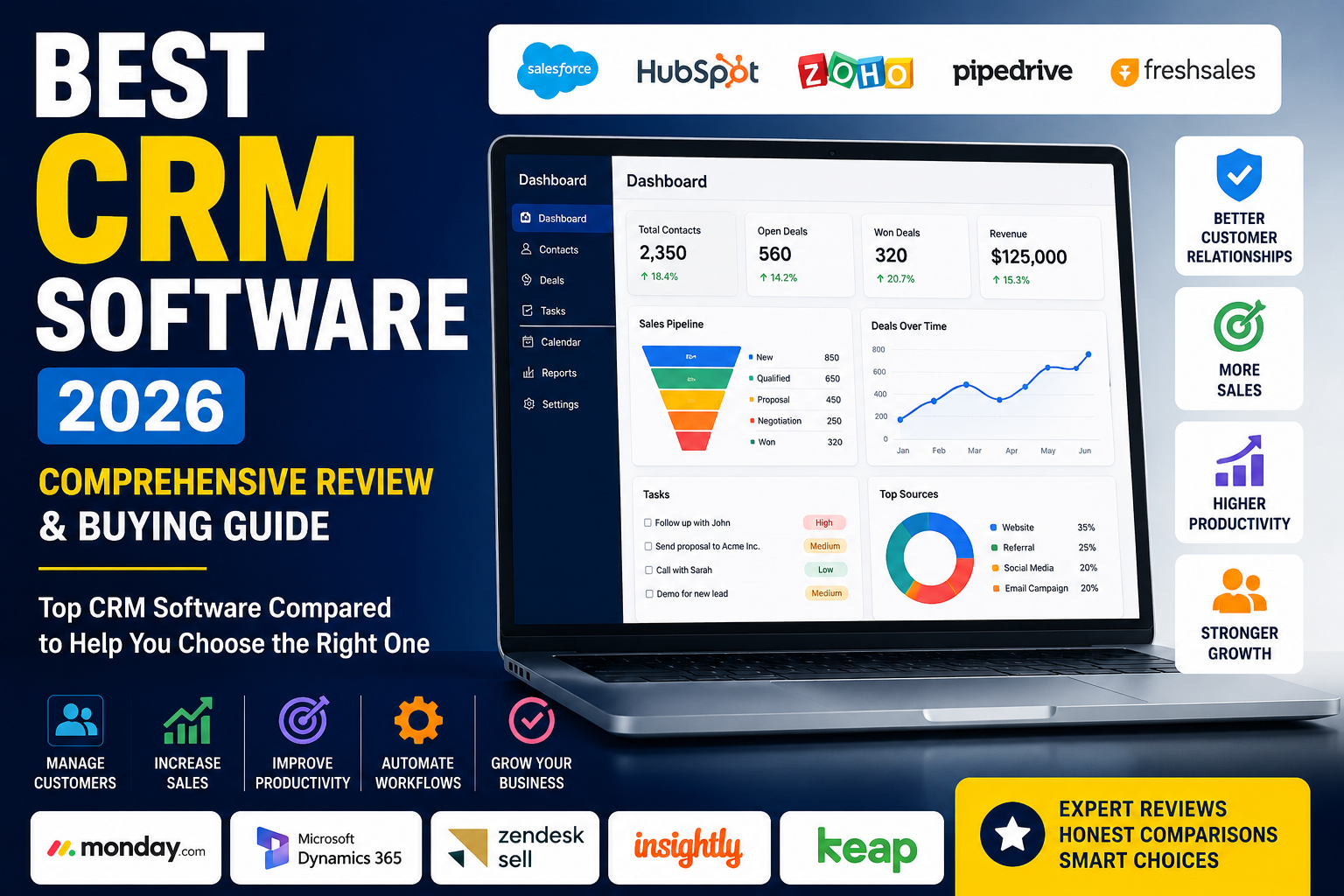
In the digital-first business landscape of 2026, Customer Relationship Management (CRM) software has evolved from a luxury to a necessity. Whether you’re a solopreneur managing a handful of clients or an enterprise orchestrating complex sales cycles across global teams, the right CRM can be the difference between chaotic growth and scalable success.
Yet despite more choice than ever—and free tiers more capable than they’ve ever been—most small businesses still run their sales processes on spreadsheets and inbox folders. Why? Because picking the wrong CRM costs more than picking none at all. The wrong choice usually means one of two things: either the platform turns out to be too heavy, and nobody actually uses it, or it’s too light, and the company outgrows it within a year.
This comprehensive review cuts through the noise. We’ve analyzed the leading CRM platforms of 2026 across dimensions that actually matter—ease of use, core functionality, automation and AI, reporting, integrations, pricing, and scalability. Whether you’re looking for a free starting point or an enterprise-grade solution, we’ll help you find the CRM that fits how you sell, without making you hate your job.
For more in-depth software reviews and buying guides, visit RightReviews —your trusted source for honest product evaluations.
What Is CRM Software and Why Does Your Business Need It?
Customer Relationship Management (CRM) software is a platform that helps businesses centralize customer information, track interactions, and automate workflows across the entire customer lifecycle. With a modern CRM, organisations can manage leads and opportunities, analyze customer behavior, run personalised marketing campaigns, streamline sales processes, and deliver more responsive customer support.
The Business Problems CRM Solves
According to Gartner, nearly half of organisations still rely on third-party tools (49%), spreadsheets (18%), or have no system at all (21%) to manage customer relationships. This creates several critical issues:
1. Customer Information Silos Across Departments
When customer information is spread across multiple databases and teams, employees waste valuable time searching for details and risk delivering inconsistent experiences. A CRM consolidates customer information into a single, intuitive dashboard, enabling faster response times and more personalised interactions.
2. Data Silos and Outdated Information
If your sales, marketing, and customer service teams are working with outdated, duplicate, or irrelevant data, it becomes difficult to effectively engage customers and prospects. CRM software automates the capture, updating, and organization of customer data while centralizing all information in one place.
3. Poor Customer Experience
Slow response times, fragmented communication, and the frustration of having to repeat the same information to multiple team members all lead to a poor customer experience. A CRM ensures every interaction is informed by the complete customer history.
4. Manual Processes and Lost Opportunities
Without automation, follow-ups get missed, leads fall through the cracks, and sales teams spend more time on data entry than on selling. Modern CRMs automate follow-up reminders, task sequences, and lead assignment.
The main drivers of CRM software adoption include inefficiencies in current processes (40%), limited functionality in existing tools (31%), and the need to capture new business opportunities (11%).
The CRM Landscape in 2026
The CRM market in 2026 is defined by several key trends:
AI Integration Is Everywhere. Modern CRM platforms use artificial intelligence to deliver predictive insights, automate routine tasks, personalize customer interactions, and improve decision-making in real time. From predictive lead scoring to autonomous sales agents that nurture leads and schedule follow-ups on their own, AI is no longer a luxury—it’s table stakes.
The Rise of Agentic CRM. The next evolution is Agentic CRM: platforms powered by role-specific AI agents that go beyond automation to act proactively on behalf of teams, helping businesses scale workflows more efficiently.
Free Tiers Are More Powerful Than Ever. HubSpot’s free plan offers genuinely powerful functionality, and Zoho CRM offers a permanent free plan for up to three users. This has lowered the barrier to entry dramatically.
Consolidation and Competition. According to ISG Research, the top three overall leaders are Salesforce, Oracle, and HubSpot. However, a wide range of specialized and mid-market solutions continue to thrive.
Best Paid CRM Software in 2026
1. Salesforce — Best for Enterprises
Salesforce is the world’s #1 CRM by market share, serving over 150,000 companies across every industry. Its Sales Cloud, Service Cloud, Marketing Cloud, and Commerce Cloud form a single platform for managing the entire customer lifecycle.
Key Features:
- Unmatched customization with custom objects, fields, and page layouts
- Massive AppExchange ecosystem with 4,000+ apps
- Advanced role-based permissions and sharing rules
- Einstein AI for activity capture, predictive insights, and automation
- Process Builder and Flow for advanced automation without developers
- Configure-price-quote (CPQ) integration for accurate quoting
Performance: Salesforce remains the default for complex enterprise processes. It handles multi-year enterprise deals with intricate approval chains and thousands of products without breaking a sweat.
Pricing: Starter Suite begins at **$25/user/month** (billed annually). Professional at $80/user/month adds pipeline management and forecasting. Enterprise starts at $165/user/month for advanced automation and APIs. Unlimited at $330/user/month includes 24/7 support.
Pros:
- Unparalleled customization and integration capabilities
- Massive ecosystem of third-party apps
- Scales from mid-market to global enterprise
Cons:
- Steep learning curve and long onboarding time
- Pricing escalates rapidly with add-ons
- Implementation often requires a certified administrator or consultant
- User interface feels dense and outdated for many reps
Verdict: Salesforce is the gold standard for medium to large enterprises with dedicated Salesforce admins, complex sales cycles, and a need for deep integrations. Not recommended for teams of fewer than 10 people unless you have a burning reason.
2. HubSpot CRM — Best Overall for Growing Teams
HubSpot CRM grabs the top spot for most small to mid-sized teams because its free plan is genuinely powerful and the paid tiers scale sensibly. It’s the most marketing-aware CRM on the market and the obvious choice for businesses where content marketing and email nurture do most of the sales work.
Key Features:
- Integrated marketing, sales, and service hub in one platform
- Free plan with unlimited contacts, pipeline management, and connected email inbox
- Sales Hub adds sequences, goals, and custom reporting
- Marketing Hub for content marketing, email nurture, and lead generation
- Service Hub for customer support ticketing and knowledge base
Performance: HubSpot consistently ranks as a leader in independent evaluations. ISG Research ranks it among the top three overall CRM leaders alongside Salesforce and Oracle.
Pricing: Free plan available. Paid Sales Hub plans start at $15/user/month (annual billing). Starter plans at approximately €15/user/month, Pro at €90/user/month.
Pros:
- Best-in-class user experience and onboarding
- Powerful free tier with genuine functionality
- Native integration between marketing, sales, and service
- Smooth upgrade path as your business grows
Cons:
- Can become expensive as you add more hubs and users
- Limited customization compared to Salesforce
- Advanced features require higher-tier plans
Verdict: HubSpot is the ideal choice for most small to mid-sized businesses that want a free, full-featured starting point and a smooth upgrade path. If marketing drives your sales, HubSpot is the obvious answer.
3. Zoho CRM — Best Value for Money
Zoho CRM is the chameleon of the bunch—it adapts to sales, marketing, support, and even inventory. It consistently over-delivers for the price, packing true multichannel engagement into a single interface.
Key Features:
- Canvas drag-and-drop layout builder for tailored record views
- Zia AI for predictive lead scoring, deal win probability, email sentiment analysis, and autonomous sales agents
- Blueprint workflow that enforces step-by-step deal progress
- Multichannel communication hub: email, phone, live chat, social
- Deep integration with Zoho’s suite (Books, Desk, Campaigns) plus 500+ third-party apps
- On-premise deployment option for strict data control
Performance: Zoho CRM is highly rated for its usability with a wide range of built-in features. It earned strong scores in independent evaluations.
Pricing: Permanent free plan for up to 3 users. Professional tier starts at $23/user/month. Paid plans use month-to-month contracts with no multi-year lock-in.
Pros:
- Feature-rich free plan and low-cost paid tiers
- Canvas customization and AI included at every level
- Strong automation engine with minimal lift
- Transparent pricing without surprise costs
Cons:
- Interface can feel cluttered, especially with many modules active
- Advanced reporting requires separate Zoho Analytics licensing
- Advanced features require significant configuration time
Verdict: Zoho CRM is the best value proposition for budget-conscious businesses that need advanced automation and multichannel engagement. The free plan for up to three users is generous, and paid tiers respect small budgets without stripping away automation.
4. Pipedrive — Best for Sales-First Teams
Pipedrive nails visual pipeline management for sales-first teams. It’s built for reps who want crystal-clear visibility into every deal.
Key Features:
- Visual pipeline management with drag-and-drop deal movement
- Activity-driven selling with built-in reminders and task automation
- Email integration and tracking
- Customizable pipelines for different sales processes
- Mobile app for on-the-go deal management
Performance: Pipedrive is an Editors’ Choice winner for small business CRM and is ideal for standalone deal tracking.
Pricing: Starts at $14/seat/month with a 14-day free trial.
Pros:
- Intuitive, visual pipeline interface
- Sales-focused without unnecessary complexity
- Strong activity tracking and follow-up automation
Cons:
- Pipedrive is a sales tool, not a business platform
- No native customer service module
- Marketing automation requires a paid add-on
- Teams that outgrow its SMB focus will eventually need to move on
Verdict: Pipedrive is perfect for sales-first teams obsessed with visual pipeline clarity and activity-driven selling. If your primary need is tracking deals through a pipeline, Pipedrive delivers with unmatched simplicity.
5. Apptivo — Best for Larger Companies
Apptivo is PCMag’s Editors’ Choice winner for its excellent flexibility and deep lead profiles. It’s a highly configurable software platform that splits its feature set into multiple modules.
Key Features:
- Modular platform combining CRM with accounting, invoicing, and project management
- Deep lead and opportunity profiles with all necessary information
- Detailed analytics tools for data exploration
- 24/7 customer support via email and live chat, plus 24/5 phone support
- Near-endless customization possibilities
Pricing: Contact vendor for pricing details.
Verdict: Apptivo is best for larger companies that need extensive customization and an all-in-one business platform. If you’re AI-averse, note that Apptivo lacks the AI-powered tools of competitors.
6. Creatio — Easiest to Use
Creatio is recognized as the easiest CRM to use and is at the forefront of the Agentic CRM movement.
Key Features:
- Agentic CRM with role-specific AI agents
- Intuitive, user-friendly interface
- Comprehensive CRM capabilities including sales, marketing, and service
- Low-code customization for business process automation
Verdict: Creatio is ideal for teams that prioritize ease of use and want to leverage cutting-edge AI agents without complexity.
Best Free CRM Software in 2026
Free CRM software in 2026 is better than ever. Most free plans limit users, contacts, or advanced features, but many still include core tools for tracking leads, organizing customer data, and managing outreach.
1. HubSpot CRM — Best Overall Free CRM
HubSpot’s free CRM provides access to various sales, marketing, customer service, commerce, content management, and operations management tools. It offers unlimited contacts, a simple pipeline, and a connected email inbox without requiring a credit card.
Verdict: HubSpot is the best overall free CRM and the go-to tool for starting a business.
2. Zoho CRM — Best Free Plan for Small Teams
Zoho CRM offers a permanent free plan for up to 3 users with contact management, lead management, and basic automation.
Verdict: Zoho’s free plan is generous and feature-rich, making it ideal for very small teams.
3. Bitrix24 — Best Full-Stack Free CRM
Bitrix24 offers a full-stack CRM plus project suite for up to 12 users without requiring a credit card.
4. SugarCRM Sugar Sell — Best for Free Users
SugarCRM Sugar Sell is recognized as best for free users.
5. EngageBay — Best for Social Media Campaigns
EngageBay offers free CRM with social media campaign capabilities.
CRM for Specific Needs
Best CRM for Small Business
Bigin by Zoho CRM is PCMag’s Editors’ Choice winner for small business CRM, thanks to its flexible dashboards and extensive integration options. It targets start-ups and SMBs, setting aside some advanced capabilities in favor of ease of use.
Other top options: Capsule CRM, HubSpot CRM, Pipedrive, and Less Annoying CRM.
Best CRM for Growing Teams
HubSpot CRM grabs the top spot for most small to mid-sized teams.
Best CRM for Enterprises
Salesforce remains the default for complex enterprise processes.
Best CRM for Start-Ups
Zoho CRM is recognized as best for start-ups.
Best CRM for Budget-Conscious Businesses
Zoho CRM offers the best value for money with advanced features at lower costs.
How to Choose the Right CRM
Selecting the right CRM system from the multitude of options can be daunting. Here’s what to consider:
1. Core Capabilities
Every CRM should offer:
- Contact and pipeline management
- Activity tracking and automation
- Reporting that’s readable in five minutes—pipeline value, win rate, and revenue by segment, surfaced cleanly
- Integrations with email, calendar, and accounting tools
2. Ease of Use & Onboarding
How quickly can your team go from zero to pipeline without help? A CRM that requires twenty minutes of data entry per deal won’t survive a busy week.
3. Automation & AI
Look for lead assignment, follow-up sequences, and smart alerts that cut manual work. AI-powered predictive scoring and next-best-action recommendations are increasingly essential.
4. Pricing & Scalability
Per-user pricing should make sense at five users and still make sense at fifteen. Consider both current costs and how they’ll grow with your team.
5. Integrations & Ecosystem
The CRM has to fit into your stack, not replace half of it. Check for connections to email, calendar, marketing, and support tools you already use.
6. Security & Deployment
Consider data protection, permissions, and whether you need on-premise or private cloud options.
Comparison Table: Top CRM Platforms at a Glance
Final Verdict
After reviewing the best CRM software of 2026, here’s our summary:
| Category | Best Choice | Why |
|---|---|---|
| Best Overall for Growing Teams | HubSpot CRM | Powerful free plan, smooth upgrade path, marketing-sales integration |
| Best for Enterprises | Salesforce | Unmatched customization, massive ecosystem, industry standard |
| Best Value for Money | Zoho CRM | Feature-rich at low cost, generous free tier, AI included |
| Best for Sales-First Teams | Pipedrive | Visual pipeline, activity-driven, intuitive interface |
| Best for Small Business | Bigin by Zoho | Flexible, easy to use, scales to full Zoho CRM |
| Best Free CRM | HubSpot CRM | Most comprehensive free plan available |
| Easiest to Use | Creatio | Agentic AI, intuitive interface |
| Best for Larger Companies | Apptivo | Modular customization, all-in-one platform |
Final Thoughts
The best CRM software in 2026 is no longer just about managing contacts—it’s about intelligently orchestrating the entire customer journey. Whether you choose Salesforce for enterprise-grade power, HubSpot for its marketing-sales synergy, Zoho for unbeatable value, or a free option like HubSpot’s free CRM or Zoho’s free tier, you’re making a strategic investment in your business’s future.
Remember: the best CRM is the one your team will actually use. Choose a solution that fits your sales process, team size, budget, and technical comfort level. Start with a free trial or free plan, involve your team in the decision, and prioritize adoption over features.
For more detailed software reviews, comparisons, and buying guides, visit RightReviews —your trusted source for honest, in-depth product evaluations.
Disclaimer: This review is based on independent testing data from PCMag, TechRepublic, ISG Research, and other reputable sources as of July 2026. Prices and features are subject to change. Always verify the latest information directly with the software provider.